
At 30: Toronto Dingos Football Club Celebrates 30 Years Of Footy
In 1995, a group of players from the Canadian Australian Football Association (CAFA) went on a football trip to play the best England had to offer. Those players started talking about something bigger than the game they were there to play. Over some beers at a London pub, Terry Wallis, Chris Cunning, Paul Tinkler - and others - kicked around an idea: what if they started their own football club?
When they returned to Toronto a small group met in the early months of 1996. The idea evolved into a plan about growing footy in Canada. By the end of the catch-up, the group established they would wear Essendon colours and the club would be called the Downtown Dingos.
In the following weeks they recruited some players from other teams and started training at a school near Bloor and Islington. On Saturday June 1st, 1996, the Dingos played their first game against Lawrence Park Rebels at Centennial Park and won by 27 points.
As the season ticked along the Dingos had their fair share of ups and downs with big wins over Balmy Beach by 114 and 109; they beat Brampton by 73 and the Broadview Hawks by 54. But they couldn't match the seasoned clubs, losing to the Eagles by 84 and 23 points and the Mustangs by 17.
The Dingos finished the season in fifth with a 7-5 record, missing out on finals by 18.3 percent. Mark Jones kicked the most goals for the Dingos that year with 22 majors. Paul Tinkler and Chris Cunning won the best and fairest. Terry Wallis was the first coach and Chris Cunning was the club's first president and captain. They capped off their first CAFA season with a footy trip to New York.
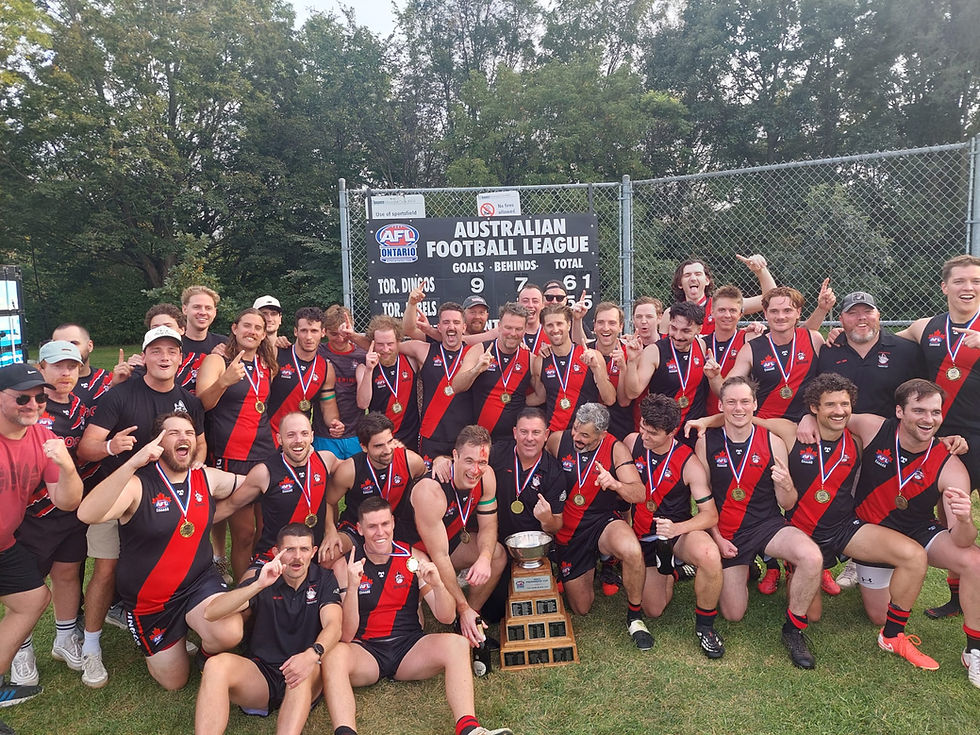
Thirty seasons.The club hasn't stopped since. The Dingos have played 329 games overall (with a 67.5 per cent winning record). They've won six premierships (four Div.1 and two Div.2). They've claimed one Wooden Spoon in 2017. Players from every corner of the world have called the Dingos home, and have called Balfour Park and the Sports Cafe home along the way.

None of it happened by accident. It happened because people kept showing up for the past three decades. The players may have changed but the club's DNA has remained.
This year the Dingos turn 30 and we're marking it properly. A club history book is in the works; a full oral history of the club told by the people who built it, played in it, and kept it alive through the good years and the hard ones. If you're part of that story and want to be involved, get in touch: justinrobertson79@gmail.com.


Comments